Plant atlas Short
Vegetable Fern: The Fiddlehead in Yam Phak Kut
Vegetable Fern · ผักกูด · Diplazium esculentum
Vegetable Fern — ผักกูด (phak-kut) — Diplazium esculentum.
Snap off a young frond while it's still wound into a tight spiral and you get a wild green that tastes grassy and turns a little slippery once it hits the wok. It grows in swampy shade along Thai ditch banks, and cooks pick only the coiled shoot tips. One rule rides along with it: cook the fronds, never eat them raw — a quick blanch is how the fern salad starts. The parts on your plate are the young curled fronds and tender shoot tips, and cooked they provide vitamin A, vitamin C, iron, calcium, and fiber.
One firm rule with vegetable fern: always cook it, never eat it raw. Raw fronds carry thiaminase, a compound that breaks down vitamin B1, and a few have shown traces of the same natural carcinogen found in bracken fern. Blanch or boil the fronds before eating, but do not treat a quick blanch as proof that every sample is free of those compounds.
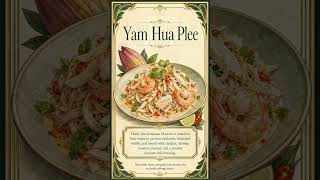
Yam Phak Kut — ยำผักกูด (yam-pak-goot)
Phak Kut Phat Nam Man Hoi — ผักกูดผัดน้ำมันหอย (pak-goot-pad-nam-man-hoy)
Food and nutrients
Rich in: Vitamin A, Vitamin C, iron, calcium, fiber
Research context
Frond extracts scavenged free radicals and slowed carb-digesting enzymes in an in-vitro test — Oxid Med Cell Longev, 2021
Sources
Source: Diplazium esculentum (Retz.) Sw.: Ethnomedicinal, Phytochemical, and Pharmacological Overview of the Himalayan Ferns. Oxid Med Cell Longev 2021; PMID:34512863 (PMCID:PMC8433033). Review of pharmacological activities: Drug Metab Pers Ther 2023; PMID:37535427, DOI:10.1515/dmpt-2023-0035.
Narration transcript
Opening
Snap off a young fern frond while it's still wound into a tight green spiral, and you've got a wild vegetable that tastes grassy and turns faintly slippery in the wok. Vegetable fern — ผักกูด, phak-kut. It grows in swampy shade along Thai ditch banks, where cooks pick only the coiled shoot tips. The part you eat is those young, curled fronds and tender tips — always cooked.
Yam Phak Kut (ยำผักกูด)
For yam phak kut, Thai cooks blanch the coiled young fronds, then toss them with fish sauce, lime, sugar and chili, often adding prawns and shallots. Eat it with sticky rice.
Phak Kut Phat Nam Man Hoi (ผักกูดผัดน้ำมันหอย)
For phak kut phat nam man hoi, the young fronds also go into the wok, stir-fried with oyster sauce and garlic until glossy and just tender, served over rice.
Nutrition summary
These coiled shoots are unusually high in iron for a green, with vitamin C, potassium, and calcium rounding it out.
Vitamin A
Vitamin A contributes to normal vision and helps maintain healthy skin and surface tissues.
Vitamin C
Vitamin C is used to build collagen and helps protect cells from oxidative stress.
Iron
Iron is part of hemoglobin, the protein that carries oxygen in your blood, and it supports normal energy metabolism.
Calcium
Calcium is needed to maintain normal bones and teeth, supports normal muscle and nerve function, and contributes to normal blood clotting.
Fiber
Fiber adds bulk to meals and can help with fullness.
Closing
One firm rule: cook vegetable fern through, and skip it raw. The raw fronds carry thiaminase — a compound that breaks down vitamin B1 — and a few have shown traces of the same natural carcinogen found in its cousin, bracken fern. A quick blanch handles both, which is exactly why yam phak kut starts in a pot of boiling water. Follow Longevity Biome, and LIKE this video for regular updates.
Related playlists
Keep watching